

Skip to content
DataMiner Dojo

More results...

Generic selectors
Exact matches only
Search in title
Search in content
Post Type Selectors
Search in posts
Search in pages
Search in posts
Search in pages
Log in
Menu
  • Updates & Insights
  • Questions
  • Learning
    • E-learning Courses
    • Tutorials
    • Open Classroom Training
    • Certification
      • DataMiner Fundamentals
      • DataMiner Configurator
      • DataMiner Automation
      • Scripts & Connectors Developer: HTTP Basics
      • Scripts & Connectors Developer: SNMP Basics
      • Visual Overview – Level 1
      • Verify a certificate
    • YouTube Videos
    • Solutions & Use Cases
      • Solutions
      • Use Case Library
    • Agility
      • Learn more about Agile
        • Agile Webspace
        • Everything Agile
          • The Agile Manifesto
          • Best Practices
          • Retro Recipes
        • Methodologies
          • The Scrum Framework
          • Kanban
          • Extreme Programming
        • Roles
          • The Product Owner
          • The Agile Coach
          • The Quality & UX Coach (QX)
      • Book your Agile Fundamentals training
      • Book your Kanban workshop
    • >> Go to DataMiner Docs
  • DevOps
    • About the DevOps Program
    • Sign up for the DevOps Program
    • DataMiner DevOps Support
    • Feature Suggestions
  • Downloads
  • Swag Shop
  • PARTNERS
    • Business Partners
    • Technology Partners
  • Contact
    • Sales, Training & Certification
    • DataMiner Support
    • Global Feedback Survey
  • >> Go to dataminer.services

Trend Group from Aggregation Rules

49 views11 hours agoAggregation rules trend groups
1
Matej Plakalovic [SLC] [DevOps Member]654 12 hours ago 0 Comments

Hi Dojo Community,

I need some help.

The customer would like to create a trending diagram with multiple individual Aggregation Rules. In short, each individual Aggregation Rule represents the Processor Max Load for a Linux Platform element.

I wanted to create a trend group, but I was surprised to see that there is no Save option after adding multiple trend graphs.
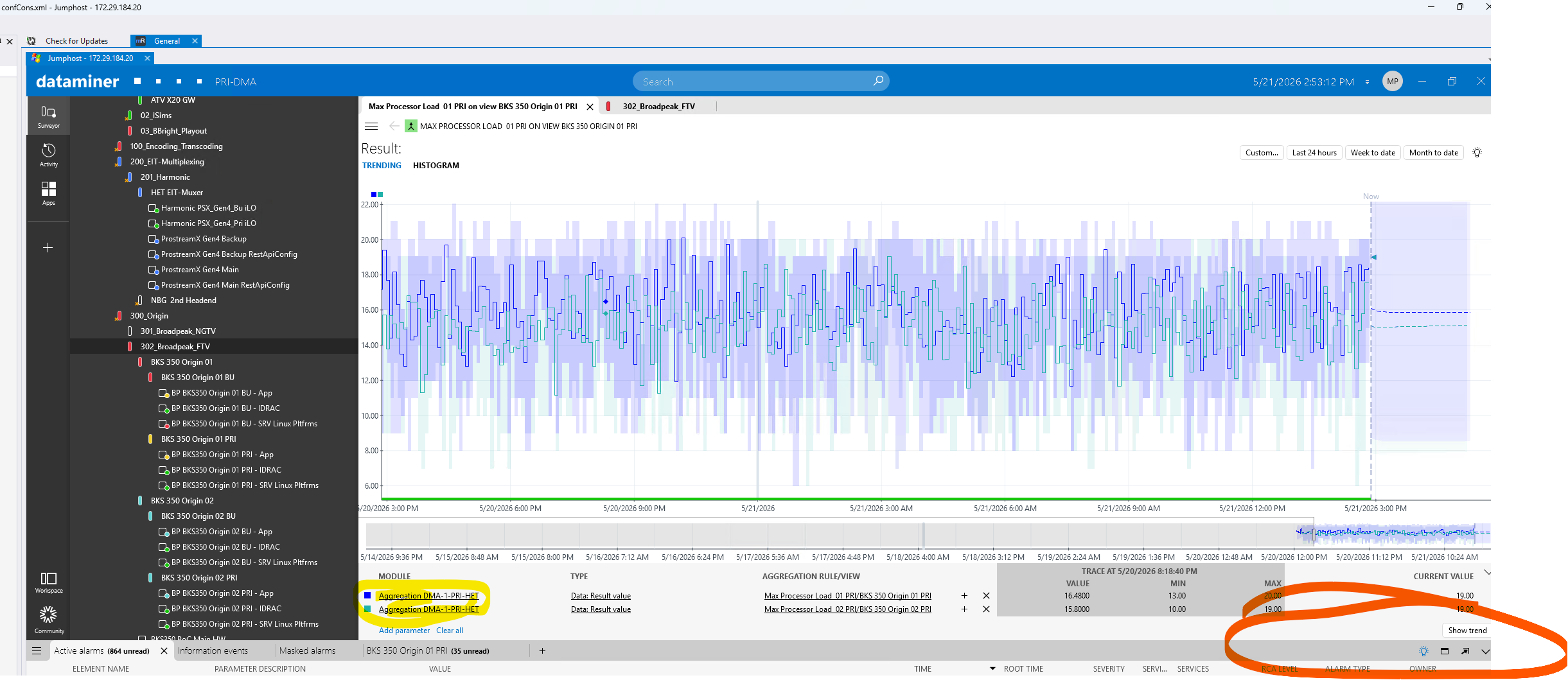
Is it possible at all to create a trend group based on aggregation rules ?

Miguel Obregon [SLC] [DevOps Catalyst] Answered question 11 hours ago

1 Answer

  • Active
  • Voted
  • Newest
  • Oldest
0
Miguel Obregon [SLC] [DevOps Catalyst]22.95K Posted 11 hours ago 1 Comment

Hi Matej,

I was able to reproduce the behavior. As far I can see, you are displaying trend graphs from aggregation rules. My guess is that since the element that exposes the aggregated values is hidden, Cube doesn't allow you to save the trend group.

When you are trying to build a trend group from scratch, you will notice that the aggregated element is not available.

A possible workaround is to build a dashboard that displays these trend graphs. To add results from aggregation rules to a trend chart, you will need to use the data source:

Parameters -> Views

Hope it helps.

Matej Plakalovic [SLC] [DevOps Member] Posted new comment 11 hours ago
Matej Plakalovic [SLC] [DevOps Member] commented 11 hours ago

I will try to offer them the option of creating a dashboard.

I checked and tried to access the hidden "Skyline Generic Aggregator <DMAID>” element, but I was not able to, even though I found on the DMA server that the element folder had been created correctly.

So, we can conclude that a trend group is not possible for Aggregation Rules.

Thank you, Miguel!

Please login to be able to comment or post an answer.

My DevOps rank

DevOps Members get more insights on their profile page.

My user earnings

0 Dojo credits

Spend your credits in our swag shop.

0 Reputation points

Boost your reputation, climb the leaderboard.

Promo banner DataMiner DevOps Professiona Program
DataMiner Integration Studio (DIS)
Empower Katas
Privacy Policy • Terms & Conditions • Contact

© 2026 Skyline Communications. All rights reserved.

DOJO Q&A widget

Can't find what you need?

? Explore the Q&A DataMiner Docs

[ Placeholder content for popup link ] WordPress Download Manager - Best Download Management Plugin