

Hi, I've built functions in the past for SRM and I used to use a functions file template. I think recently the templates got rolled into the Visual Studio Templates package but it's not included in there.
For Media Ops it looks like the same or similar functions are used, is there a template available in DIS?
Thanks,

SRM (SRM Framework) started from what DataMiner does best and that is monitoring and controlling your infrastructure. To make SRM work, you need to start with 1) building functions (also known as virtual functions) on top of connectors and profile definitions. These functions describe how resource(s) can be made for elements what the in/outputs are. The functions can then be used to 2) build service definitions (workflow of such function blocks). You can then create a booking based on a service definition and select resources for every block that were created based on the respective function. To get all the pieces for SRM you need quite a lot of knowledge to put all pieces together.
This is where MediaOps.Plan is different, the functional blocks used to build workflows are resource pools and you can start with something as simple as just a name to define a function to make it as simple as possible to build workflows for your resource management. In other words, you can start from building virtual resources and workflows and add the monitoring and control later, while for SRM you have to build the monitoring and control layer first to work with workflows. Note: that you can also make use of any existing resources that already existed on your DataMiner system with MediaOps.Plan.
MediaOps.Plan makes use of resource and reservation instance in DataMiner to do resource management. The SRM framework does this as well and has a serviceServiceReservationInstance on top of the reservation instance to extend the reservation instance (mainly for service monitoring). In the case of MediaOps.Plan we extend the reservation instance with a DOM instance and we also extend the resources with a DOM instance. So both MediaOps.Plan and the SRM framework make use of DataMiner resources, but MediaOps does not rely on the 'SRM framework' (booking manager).
Let me know if this answers your question.

It is possible to create resources in MediaOps that use virtual functions. In the Scheduling app you can then reserve those resources, but monitoring and control is not (yet) covered through the MediaOps solution. With the upcoming release (1.5.0) we will provide the option to define which scripts have to be executed on the different events for certain type of nodes. As part of those automated actions you can then also create/start your service monitoring (through code). Seeing/coupling the service state from your created service to the job to see it in the scheduling application is on our backlog but not yet scheduled (this might change depending on ongoing project requirements).
RNs preview: https://docs.dataminer.services/release-notes/MediaOps/MediaOps_1.5.0.html
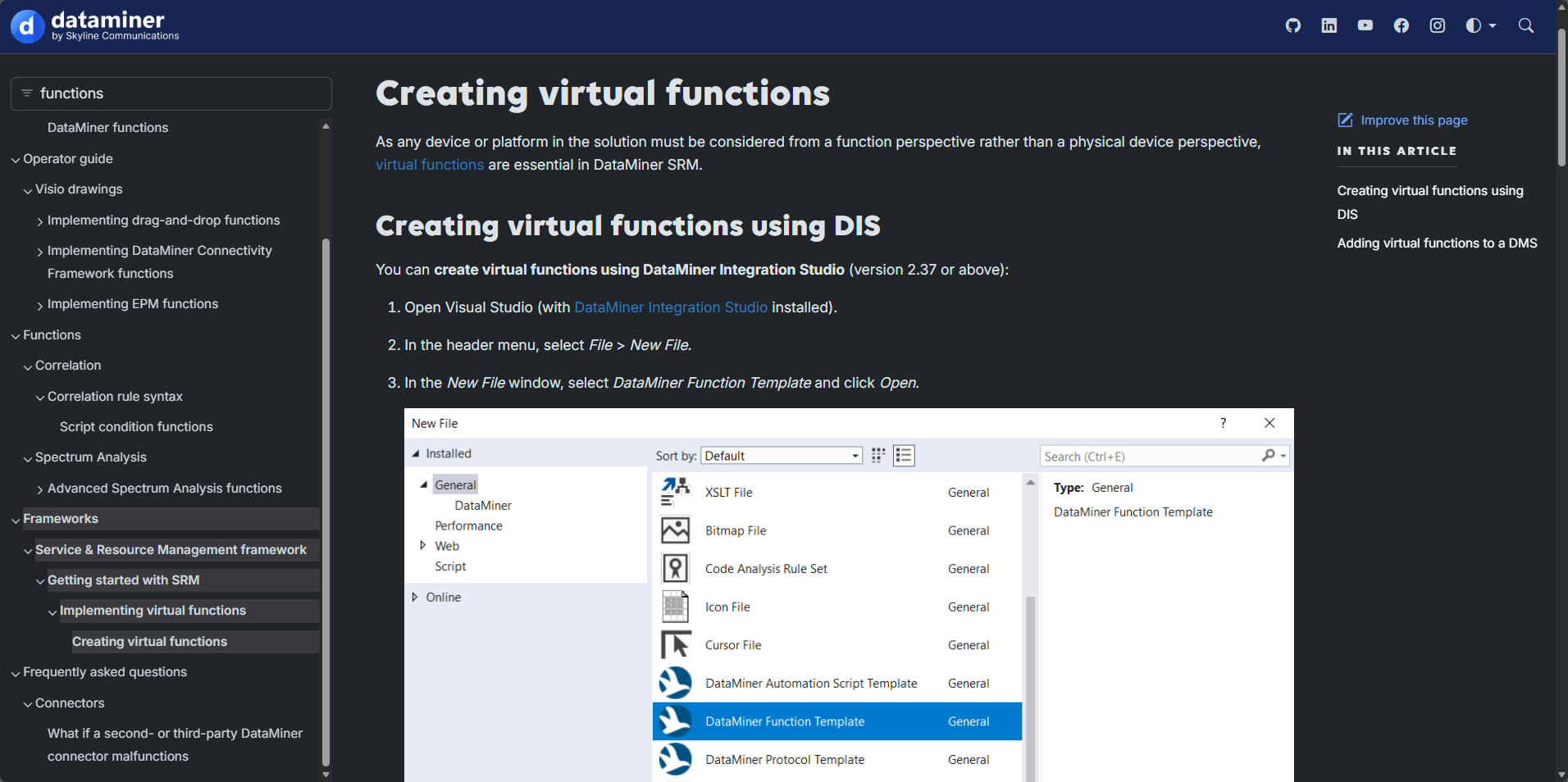
Thanks for the information, it's very helpful. I've updated the question with an image from docs which shows the template I'm trying to find. It doesn't appear to be in DIS anymore and isn't in the VS templates package. Does this template and function display editor still exist? I want a Resource for each row in a table/s of an Element. Are you saying this can be done in MediaOps and I don't need a virtual function?