The end of “cloud-washing” — For the past decade, the media industry’s digital transformation was often just a rebranding exercise. Workloads moved from bespoke hardware to Virtual Machines (VMs), but the operational philosophy stayed the same: monolithic, rigid, and resource-heavy.
In 2026, we are witnessing a genuine pivot. Large media organizations are shifting from simple virtualization to managed, microservice-oriented compute stacks. Moving to Cloud-Native Functions (CNFs) on generic compute platforms like Kubernetes, AWS, or Azure promised agility — but it also introduced a new challenge: the observability and orchestration gap.
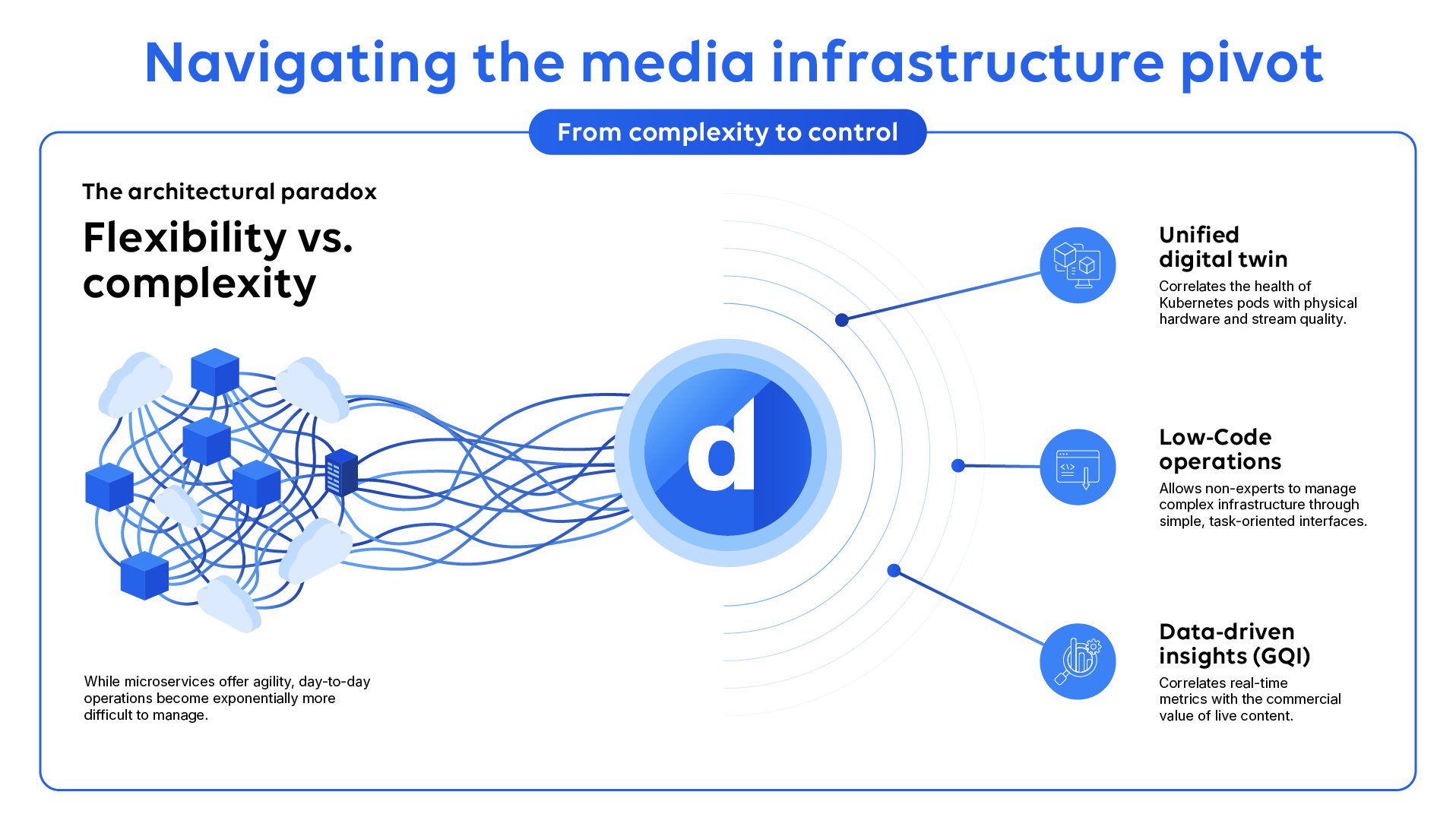
The architectural paradox: flexibility vs. complexity
As a Solution Architect, I frequently encounter the same paradox: the more flexible the infrastructure becomes, the more complex day-to-day operations get.
In traditional setups, you knew exactly where your encoder was — it was a box in a rack or a static VM. In a microservices architecture, your “broadcast chain” is an ephemeral collection of pods, distributed across a hybrid fabric, communicating over an IP underlay.
The risk? Without the right foundational platform, engineering teams spend more time managing “plumbing” than delivering content.
DataMiner: the foundational platform for generic compute
To simplify this environment, basic monitoring isn’t enough. We need a platform that acts as the architectural glue between high-level MediaOps and the low-level compute stack. Within the DataMiner ecosystem, this is achieved through three core pillars:
1. The unified digital twin
DataMiner creates a real-time, vendor-agnostic model of your entire stack. It correlates the health of a Kubernetes pod with the performance of the physical NIC and the quality of the SRT stream passing through it. This “full-stack” visibility ensures that when a service degrades, you aren’t hunting through logs — you are looking at a correlated root cause.
2. Democratizing operations with Low-Code Apps
We cannot expect every media operator to be a Kubernetes expert. DataMiner Low-Code Apps provide intuitive, task-oriented interfaces. Whether spinning up a pop-up channel or re-routing a contribution feed, operators interact with simplified business logic, while DataMiner handles the complex API calls to the generic compute layer behind the scenes.
3. Data-driven insights via GQI
The Generic Query Interface (GQI) is the engine for modern MediaOps. It lets us query data from any source — cloud billing APIs, telemetry from microservices, or historical performance data — and present it in ways that matter to the business.
Example: Correlating real-time CPU consumption on a generic compute cluster with the commercial value of the live stream it’s processing.
Conclusion: orchestration is the new monitoring
Transitioning to a managed microservice stack is more than a hardware refresh; it is a fundamental shift in thinking about media reliability. Generic compute stacks offer scale, but DataMiner provides the control.
By abstracting infrastructure complexity, media companies can focus on what they do best: creating and delivering world-class content without getting lost in the microservices maze.
Architectural takeaway for decision makers
- Scalability: Move from static capacity to elastic, demand-driven scaling.
- Integration: Use User-Defined APIs to bridge the gap between legacy broadcast tools and modern IT stacks.
- Security: Implement automated security workflows directly into the orchestration layer.